Artillery: the factory fires back
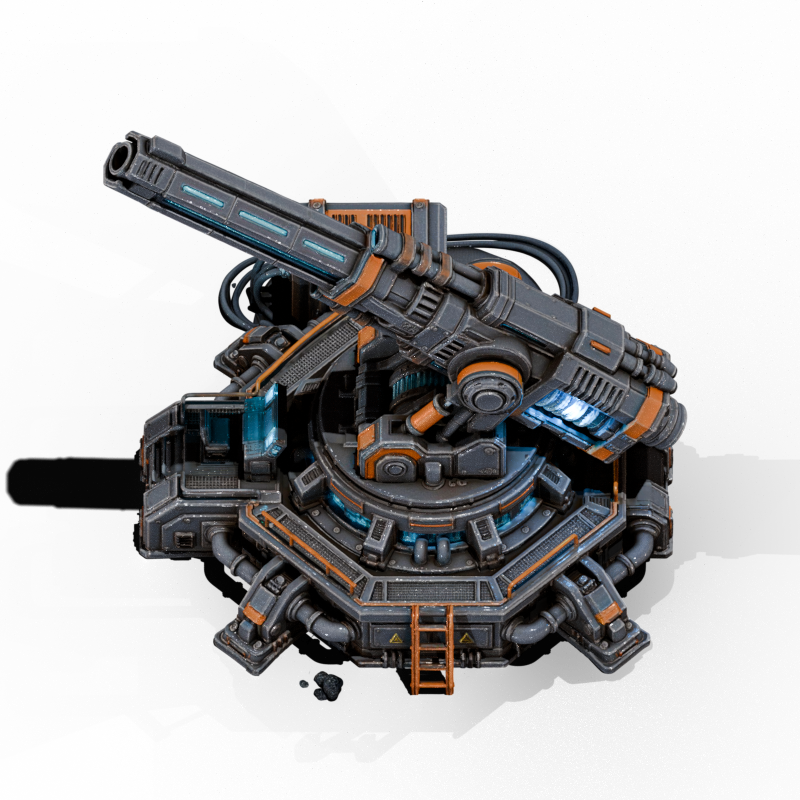
There comes a point in every factory's life when another defensive turret is not the answer. The AUTONs have bases beyond the safe zone. Those bases own the surrounding ground, launch defenders, and make every expansion route a little more hostile than it looked on the map.
So I added artillery.
Because why not? More weapons means room for more enemies, more pressure, and more of the RTS decision-making I want in The Last Factory. The factory should not only survive attacks. It should be able to plan one.
A weapon for a different job
The Artillery is a tier-three siege weapon built for targets your normal turrets cannot comfortably reach. It does not automatically pick whatever is closest. Select the gun, choose Set Target, and designate any revealed tile between its minimum and maximum range. The mission stays active until you clear it or choose somewhere else to ruin.
Each shell takes about a second to cross the map. There is a real launch, a visible arc, and then a blast at the designated tile. One hit deals 90 damage across a 1.5-tile radius, and the gun takes four seconds to load the next round. A clean AUTON base needs six good hits. The Artillery can hold eight shells, but every shot has to be manufactured and delivered by the factory.
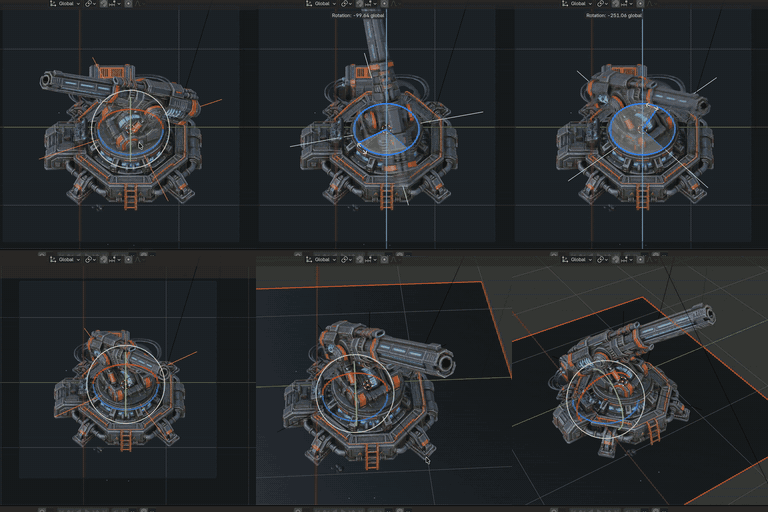
The long range comes with a four-tile blind spot, so this is not a bigger turret that replaces everything else. It is a siege platform that needs a defended position, a working power grid, and a reliable supply line.
AUTON territory now has an answer
AUTON bases are no longer indestructible map furniture. A discovered base has 500 durability, occupies a two-by-two footprint, and controls the fight around it. Build too close or start firing and it wakes up, launching scouts and breakers from the perimeter.
Shelling a base also tells it exactly where the attack came from. Its next defenders do not wander toward the nearest convenient conveyor; they march on the gun. That makes every fire mission a commitment. You need turrets covering the battery, enough ammunition to finish the job, and a plan for the wave that is already on its way.
Destroy the base and it stays destroyed. The footprint becomes buildable, the defender waves stop, and the factory recovers 20 salvage. Ground that was AUTON territory is now yours, earned through production and firepower rather than a passive reveal radius.
Friendly fire means friendly fire
Artillery can target any revealed ground tile, not only a base or an enemy. That makes it useful against a clustered raid, but the blast does not care who built the structures inside it. Enemies, AUTON bases, and your own modules all take the same hit.
There is no random scatter in this first version. Shells land exactly where you order them because the decision is already dangerous enough. Put the crosshair on your own belt junction and the gun will follow instructions with professional enthusiasm.
Shells are a new Workbench recipe: two Ammo and one Alloy Plate for one round. The Artillery itself also reaches deep into the production chain, using Iron Ingots, Alloy Plates, Frames, Circuits, and Sensors. Unlocking Ballistic Computation gives you the weapon, but operating it is a factory problem: materials, power, transport, storage, and protection all have to agree before the first shot leaves the barrel.
More RTS, on purpose
This changes how the frontier works. Scouting tells you where the bases are. Terrain decides where a battery can be supplied and defended. Turrets hold the line and still prioritize live enemies, but when the area is clear they can chip away at a discovered base in range. Artillery handles the targets farther out. The AUTONs answer by attacking the weapon that threatened them.
That creates the loop I was looking for:
- Reveal hostile territory.
- Establish power and a shell supply line.
- Pick a firing position and protect its blind spot.
- Designate the base and survive the counterattack.
- Destroy it, claim the land, and push the factory forward.
It is still a factory-automation game. Production remains the source of every solution. There are simply more reasons to care where that production goes, how quickly it gets there, and whether the route can survive contact with the enemy.
More weapons. More enemies. More territory worth fighting over. More RTS.
That seems like enough reasons to build a very large gun.